Electric cars have a full booth at the Washington Motor Show
Electric cars are in high demand right now, and the Washington DC Auto Show has been featuring alternative fuel cars for 15 years, but this is the first year that an entire pavilion has been dedicated...
And if Joe Biden implements his ambitious $2.2 trillion Build Back Better plan, there should be 50% zero-emission vehicles on the road by 2030.
The Biden administration also plans to convert about 600,000 of its fleet to alternative fuels as part of a renewed commitment to combat climate change.
And there are major issues ahead - the plan has been blocked by Republicans and there are entitlement issues that must be resolved as the U.S. moves away from fossil fuels. But big changes are happening.
Electric vehicles are now being embraced globally, and the show, which focuses on public policy and gives members of Congress and auto industry leaders a space to examine the latest technologies, needs to reflect that, said John O'Donnell, executive director of the Washington DC Auto Show.
"I think it's now very important for us to make the show bigger and more popular because of the current debate about electric cars in Washington and to dispel the myth that U.S. auto dealers don't want to sell electric cars," O'Donnell added. .
A strong transition like Biden envisions requires an equally comprehensive infrastructure overhaul. In the bipartisan Infrastructure Investment and Jobs Act, $7.5 billion is earmarked for electric vehicle charging infrastructure and building charging stations along highways. But the industry is concerned about how that money will be spent.
It's important that today's chargers are able to charge faster than the cars on the market today. Cars are growing every year.
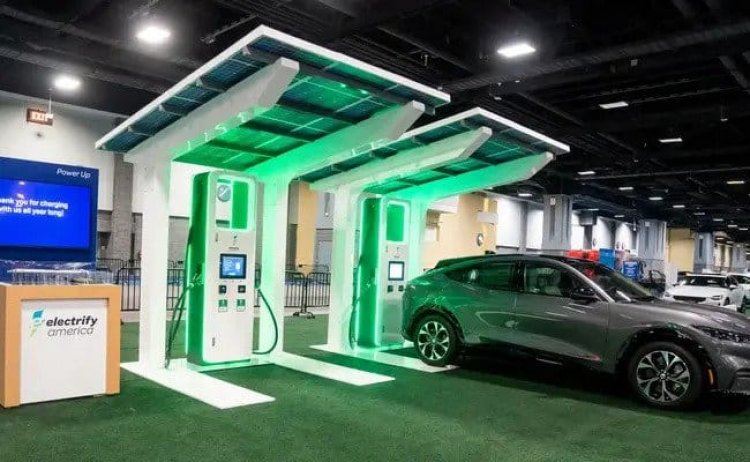
Electrify America, the sponsor of the EV booth at the auto show, has the largest network of DC charging stations in the United States.
Auto Show dedicates entire pavilion to electric cars
Electrify America's network currently consists of 800 charging stations, most of which are located along highway lanes. The company plans to increase the number to 1,800 charging stations with 10,000 chargers by 2026.
However, 500,000 charging stations are needed to meet Biden's goals, and they must be reliable and not dedicated to a single brand.
There are 31 different U.S. automaker brands using the same charging standard, and it is in the public interest to build on the consensus around this single standard.
The biggest concern for consumers right now is the bottom line. Electric vehicles are more economical than gasoline-powered cars.
The average price of an e-gallon - the cost of driving a similar vehicle the same distance on a gallon of fuel - is $1.16, compared to $2.85 for fuel.
And because Electrify America offers general shipping rates, their rates are slightly higher than domestic chargers. But standard in every state.
Congress has amended the Public Utilities Regulation Act. This law requires each state to consider utility rates for electric vehicles. This gives each state the freedom to change unfavorable rates for electric vehicle certification.
These application fees result in extremely expensive electricity charges, making it difficult to keep prices low.
Incentives to support electric vehicle charging infrastructure are an important tool to make electric vehicle use more equitable. There is also a greater need for electric vehicle charging infrastructure.
The lack of affordable, equitable, and reliable charging infrastructure is the biggest barrier to electric vehicle adoption.